
Getting Started and Presidencies

This month finds me knee-deep in work on an upcoming episode about Monroe’s tour of the North and Midwest in the summer of 1817. Working on this episode about the first few months of Monroe’s presidency prompted me to reflect on how other chief executives got started with their first (and in some cases only) presidential term. While they may have wished for time to get a handle on things, that was not always the case, and some handled early challenges better than others.
The Slow Start
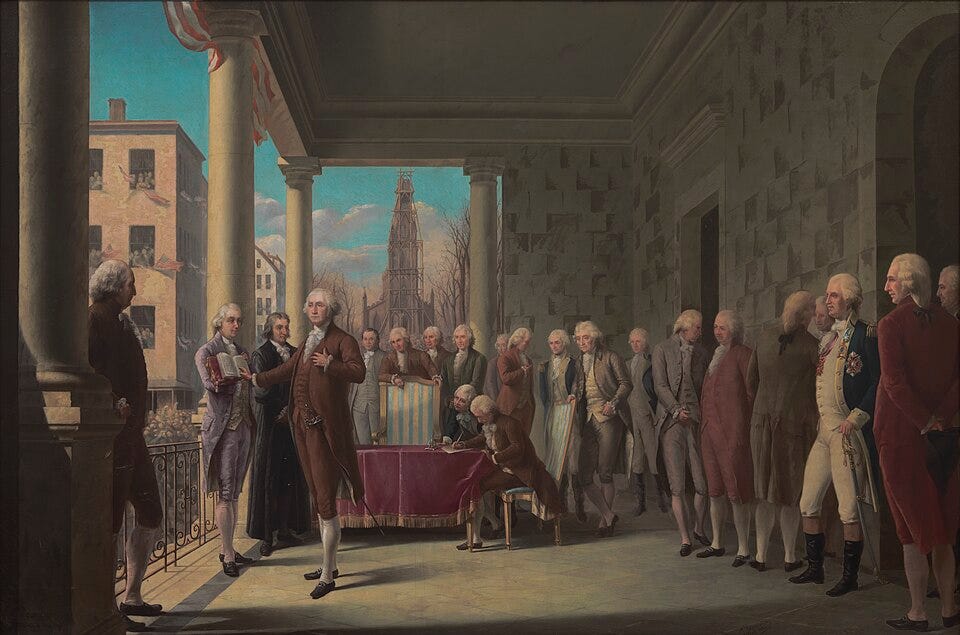

When George Washington took the oath of office for the first time on April 30th, 1789, he was one of few people employed by the federal government. The new Congress had only been meeting for a month in its first session. John Adams had been inaugurated as VP a week and a half before. There was a small army and a few officials inherited from the Confederation government, but that was it.
It would take time for Congress to establish the federal departments, for Washington to appoint the first Supreme Court justices, and for the basic scaffolding of the new Constitution to be put in place. Indeed, the largest public debate in May 1789 was how the new President should be referred to - whether he needed some grandiose title or, as some folks suggested, they should just go with the simple “Mr. President.”
Thus, Washington got a slow start to his administration. He had time to start thinking through social protocol with advise gathered from other prominent leaders including VP Adams, Rep. James Madison, and the outgoing Secretary of Foreign Affairs, John Jay. Towards the end of the month, he was able to welcome his wife Martha to New York City, and they hosted the first state dinner at their lodgings on Cherry Street. This ideal of being able to take time to sort things out before the pace picked up would prove to not be the norm for many of Washington’s successors.
Panic!
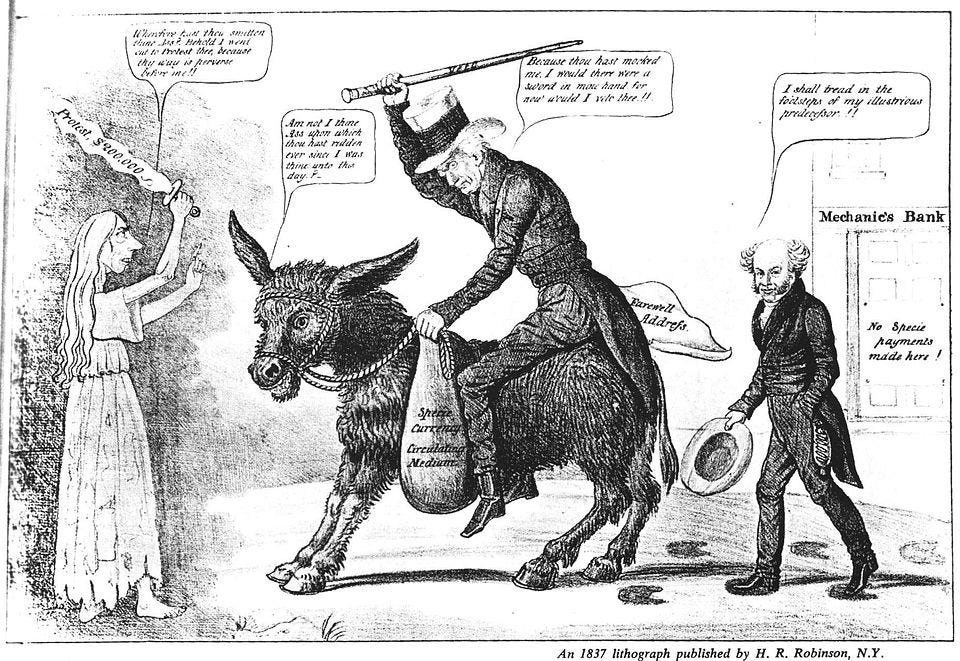
When he took the oath of office on March 4th, 1837, the 54-year-old Martin Van Buren was the youngest person to that point to become president. Sadly for Van Buren, that’s not what his presidency would be remembered for, as on May 10th of that year, state banks in his home state of New York began to run out of hard currency reserves and refused to redeem their paper notes for specie. While it’s beyond the scope of this newsletter to go into all the details, just know that this would cascade into a financial crisis that would come to be known as the Panic of 1837.
There are numerous causes for the Panic, but the timing meant it was in the wake of his predecessor Jackson’s Bank War to bring down the Bank of the United States, an institution originally conceived as a stabilizing influence on the national economy, and his Specie Circular, which contributed to a slow down of the real estate investment market. Thus, Jackson and his chosen successor Van Buren were targeted by their political opponents as being the cause of the nation’s economic woes.
Van Buren would spend the remainder of his term in office fighting off these attacks and using what limited options he had at the time to try to address the problem, primarily by pushing for Congress to pass his Independent Treasury proposal. Needless to say, it was not an easy time, and ultimately, the man dubbed “Martin Van Ruin” was denied a second term in office.
The Ultimate Challenge - Death
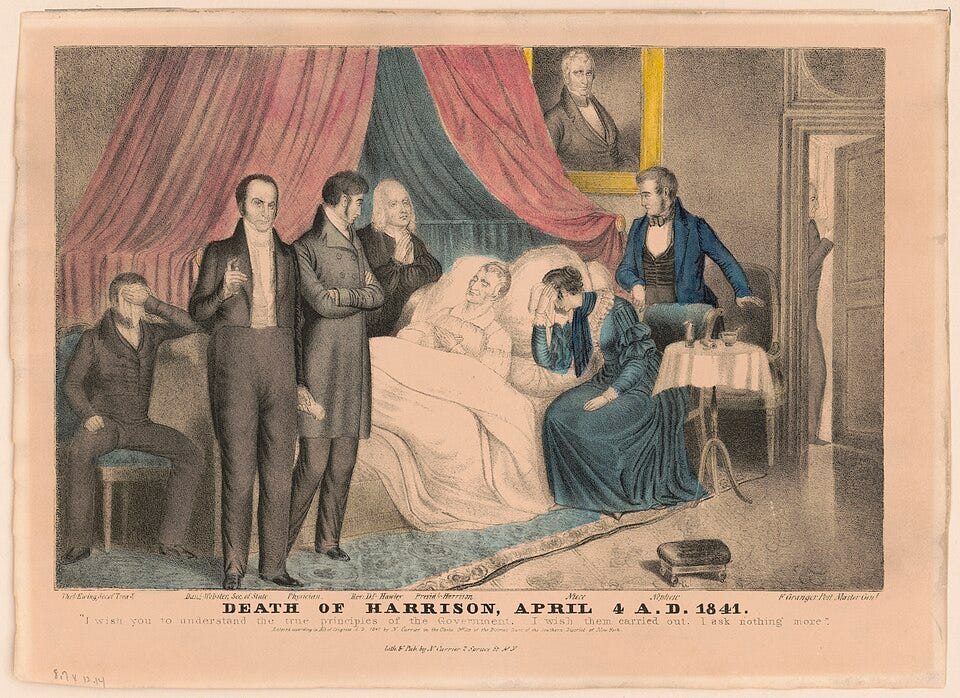

For a couple of presidents, a few months in office was all they had - William Henry Harrison and James A Garfield didn’t have time to settle in good before tragedy happened to bring their presidencies to an end. Though there were distinct differences, the majority of their respective short tenures was spent dealing with issues of patronage - hearing applicants for federal office, sifting through recommendation letters from prominent politicians across the nation, and trying to balance the demands of the factions of their political party through appointments.
Though their tenures were four decades apart, both Harrison and Garfield had powerful political leaders with whom they had to contend. For Harrison, Sen. Henry Clay thought that, as the leading force in the Whig Party and decades of being a political mover and shaker in Washington, he would be able to have Harrison do his bidding. However, the new President made it very clear that there was only one president at a time and that Clay could stay on Capitol Hill until he was summoned. Clay thought he had another shot when Tyler assumed the presidency upon Harrison’s demise, but he turned out to be sorely mistaken there.
Likewise, Sen. Roscoe Conkling thought that, as the head of a powerful political machine and with one of his trusted lieutenants, Chester Arthur, as vice president, he’d be able to get what he wanted out of the Garfield administration. The new president however had other ideas. When Conkling resigned in a power play to prove his political strength by having the New York state assembly promptly reelect him, it ultimately proved to be his undoing when another was chosen as his successor. Garfield had won the political battle but had little time to celebrate before he was shot. Rather akin to Clay, Conkling thought when Arthur succeeded to the presidency with Garfield’s passing, he might be back in the game, but it was not to be - Arthur would take up the cause of civil service reform, and Conkling would never achieve the power he once held before passing away a few years later.
As we continue our journey through the early days of Monroe’s presidency, we’ll have to gauge just how successful he was in launching his administration. Speaking of…
Latest Episodes
It’s been a busy time lately in terms of getting episodes out! We’ve hit on all the series in the last few weeks with an interview about politics in the 1960s and 1970s, a Monroe presidency series about his inauguration and early days, a President pro tempore episode about a rather fascinating figure from Tennessee, and last but certainly not least, a two-part Seat at the Table episode featuring Rob and Jamie from Totalus Rankium.
The latter has been long in coming as we actually recorded a few months back. Editing took a while, but it’s finally done and available. Hope you’ll check out all of these episodes if you haven’t already!
Interview Series
Monroe Presidency Series
Seat at the Table Series
Diligent and Durable: Samuel Southard and the Politics of the Early Republic Part One (SATT 035.1)
A Figure of Weight: Samuel Southard and the Politics of the Early Republic Part Two (SATT 035.2)
Vice Presidencies Series
May Birthdays
Even though a year has passed and we’ve had plenty of episodes since, there’s still only two May birthday folks that we’ve covered to date. While they’re not necessarily household names, the episodes on both provide insight into their times and the respective administrations that they served.
One may even have been nominated and confirmed to the Supreme Court, though he would ultimately decline the post. Which one is it? You’ll just have to listen to both episodes to find out!
May 14: Samuel Dexter (1761)
May 15: Levi Lincoln Sr (1749)
And finally…
As the days grow longer and warmer in the northern hemisphere, I’m looking forward to having some more time this summer to read, research, and work on more podcast episodes. There’s so much ahead including looking at the situation with the wars for independence in the Americas when Monroe took office because there will be much to discuss there, an examination of the life and legacy of Elizabeth Monroe and her daughters, and some key events in Monroe’s first term that will have impacts lasting through the next few presidencies.
I am so grateful to have all of you on this journey with me, and I could not do what I do without all of you. The Presidencies Podcast has been featured recently on the Best 50 POTUS Podcasts in the US list from Million Podcast, and it keeps growing in terms of listeners, social media followers, and subscribers to this newsletter. Word of mouth brings so many folks along, so I cannot thank all of you who have been helping me get the word out there and sending folks this way.
If you’d like to support the podcast, there are numerous ways to do so including becoming a paid Substack subscriber as well as through Patreon and Buy Me a Coffee. You can also fulfill requests from my book wish list in order to ensure that my research is as comprehensive as possible. To all who have shown their support thus far over the years, I cannot thank you enough!
Leaving a rating and review is also a great way to show your support, and thanks to all who have taken a minute to do so!
Please feel free to reach out to me via email at presidenciespodcast@gmail.com or connecting on the various social media outlets Presidencies can be found on.
Until next time, stay safe and healthy, be kind to one another, and take care, dear friends!